Clinical Data

iStent® Clinical Data

Trabecular micro-bypass technology developed by Glaukos has been studied extensively around the world and its efficacy has been demonstrated in over 200 peer-reviewed articles, 20 years of clinical use, and over one million eyes.

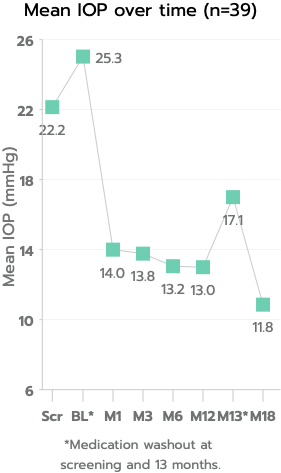
The implantation of two trabecular bypass stents – without the benefit of cataract surgery – has been shown in prospective clinical trials as described below to both lower IOP to <15 mm Hg and reduce medication burden via a unique two stent approach:

Independent Clinical Study Results

Additional independent, long-term studies of Glaukos trabecular micro-bypass technology suggest that results are maintained several years after the procedure.

Study (duration) # of Subjects (at endpoint) Post-Op Mean IOP (mmHG) % IOP Reduction % Medication Reduction
Study (duration) Guedes2 (12M) # of Subjects (at endpoint) 23 Post-Op Mean IOP (mmHG) 13.1 % IOP Reduction 19.1% % Medication Reduction 94.1%
Study (duration) Clement3 (12M) # of Subjects (at endpoint) 165 Post-Op Mean IOP (mmHG) 14.0 % IOP Reduction 23.2% % Medication Reduction 71.5%
Study (duration) Manning4 (12M) # of Subjects (at endpoint) 70 Post-Op Mean IOP (mmHG) 14.4 % IOP Reduction 29.4% % Medication Reduction 94.7%
Study (duration) Hengerer5 (84M) # of Subjects (at endpoint) 125 Post-Op Mean IOP (mmHG) 14.1 % IOP Reduction 40.0% % Medication Reduction 59.0%
Study (duration) Arriola-Villalobos6 (48M) # of Subjects (at endpoint) 20 Post-Op Mean IOP (mmHG) 16.25 % IOP Reduction 36.92% % Medication Reduction 42.3%

Can Reduce Intraocular Pressure (IOP) and
Medication Burden

Numerous studies have demonstrated that iStent inject® is effective in lowering IOP at the discretion of a physician.

In one consecutive case study involving multiple international surgeons, a mean IOP reduction of 34% vs. medicated screening (13.6 mmHg vs. 20.6 mmHg) was found at 12 months.6 Additionally, average medication usage was reduced from 1.0 to 0.1.6

Long-Term IOP Reduction5

Another study conducted by multiple international surgeons found postop medication-free mean IOP was 8.2 mmHg lower than preop unmedicated mean IOP, showing that use of stents alone resulted in a 32% IOP reduction.7

Sustained Medication Reduction5

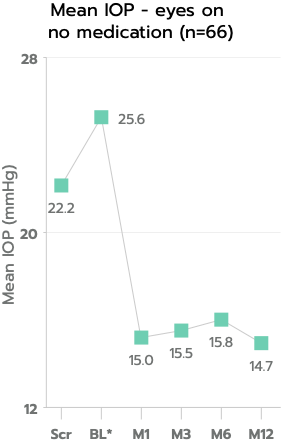
Line chart showing the mean IOP over time with a mean IOP reduction of 34% as compared to the medicated screening.

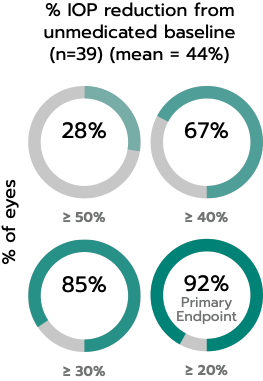
In the 12-month postoperative visit of the Synergy Study, a multi-centre study conducted in Europe, subjects who remained off medication demonstrated a mean IOP reduction of 34% as compared to the medicated screening.8 The Synergy Study also showed that 72% of patients experienced IOP reduction ≥20% without medication at 12 months postoperative.8

At 12 month post-operative visit8:

Medication reduction is subject to the discretion of the physician.

References

  1. Guedes RAP, Gravina DM, Lake JC, Guedes VMP, Chaoubah A. Intermediate results of iStent® or iStent inject® implantation combined with cataract surgery in a real-world setting: a longitudinal retrospective study. Ophthalmol Ther. March 2019;8(1):87-100.
  2. Clement CI, Howes F, Ioannidis AS, Shiu M, Manning D. One-year outcomes following implantation of second-generation trabecular micro-bypass stents in conjunction with cataract surgery for various types of glaucoma or ocular hypertension: multicenter, multi-surgeon study. Clin Ophthalmol. 2019:13;491-499.
  3. Manning D. Real-world case series of iStent® or iStent inject® trabecular micro-bypass stents combined with cataract surgery. Ophthalmology & Therapy. 2019. doi:https://doi.org/10.1007/s40123-019-00208-x.
  4. Hengerer FH, Auffarth G, Conrad-Hengerer I. Sustained 7-year glaucoma control after second-generation trabecular micro-bypass with or without cataract surgery. Abstract presented at: Annual Meeting of the American Society of Cataract and Refractive Surgery; May 5-8, 2023; San Diego, CA.
  5. Arriola-Villalobos P, Martinez-de-la-Casa JM, Diaz-Valle D, et al. Glaukos iStent inject® trabecular micro-bypass implantation associated with cataract surgery in patients with coexisting cataract and open-angle glaucoma or ocular hypertension: a long-term study. J Ophthalmology. 2016;1-7.
  6. Chang, DF. Intraocular Pressure Reduction and Safety Outcomes After Micro-Invasive Glaucoma Surgery with 2 Trabecular Bypass Stents in OAG. Presented at the 2013 American Society of Cataract and Refractive Surgery Annual Meeting; April 19-23, 2013; San Francisco, California, USA.
  7. Ahmed II, Katz LJ, Chang DF, Donnenfeld ED, Solomon KD, Voskanyan L, Samuelson TW. Prospective evaluation of microinvasive glaucoma surgery with trabecular microbypass stents and prostaglandin in open-angle glaucoma. J Cataract Refract Surg 2014 Aug;40:1295–1300.
  8. Voskanyan L, García-Feijoó J, Belda J, Fea A, Jünemann A, Baudouin C. “Prospective, Unmasked Evaluation of the iStent inject System for Open-Angle Glaucoma: Synergy Trial”. Adv Ther 2014; 31:189-201.

We’re here to answer questions and provide any additional information you may need.

"*" indicates required fields

This field is for validation purposes and should be left unchanged.

New Zealand iStent inject® W Important Safety Information

Indication for Use

The iStent inject® W Trabecular Micro-Bypass System (Model G2-W) is intended to reduce intraocular pressure in adult patients diagnosed with mild to moderate primary open-angle glaucoma (POAG) currently treated with ocular hypotensive medication. The device can be implanted with or without cataract surgery.

Contraindications

The device is contraindicated for use in eyes with primary angle closure glaucoma, or secondary angle-closure glaucoma, including neovascular glaucoma, because the device would not be expected to work in such situations, and in patients with retrobulbar tumor, thyroid eye disease, Sturge-Weber Syndrome or any other type of condition that may cause elevated episcleral venous pressure.

Warnings

This device has not been studied in patients with uveitic glaucoma. Patients should be informed that placement of the stents, without concomitant cataract surgery in phakic patients, can enhance the formation or progression of cataract. The surgeon should monitor the patient postoperatively for proper maintenance of intraocular pressure. iStent inject® is MR-Conditional, meaning that the device is safe for use in a specified MRI environment under specified conditions; please see labelling for details. Physician training is required prior to use. Do not re-use the stent(s) or injector.

Adverse Events

Postoperative adverse events include but are not limited to: corneal complications including edema, opacification and decompensation, cataract formation (in phakic patients), posterior capsule opacification, stent obstruction, intraocular inflammation (non-pre existing), BCVA loss and IOP increase requiring management with oral or intravenous medications or surgical intervention. Please refer to Directions for Use for additional adverse event information.

Caution

Please reference the Directions For Use labelling for a complete list of contraindications, warnings and adverse events.

Please Select Your Country

Continue